
Unschooling Moms Have More Fun
Aug 07, 2026I have finally figured out the secret to successful unschooling.
It is not finding the perfect curriculum.
It is not creating better educational activities.
It is not turning your kitchen into a Montessori classroom or making sure every spontaneous interest somehow checks three boxes on a state learning standard.
It is much simpler than that.
Mom needs to be having fun.
I am completely serious.
In fact, I have started to believe that one of the biggest mistakes we make when we think about homeschooling — and especially unschooling — is continuing to ask the same question school asks:
Is this educational?
I almost never ask that question.
The question I ask is:
Would this be fun?
More specifically:
Would this be fun for me?
And if the answer is yes, there is a very good chance I am going to say yes.
I am not sacrificing myself for their education
There was probably a time when I would have been embarrassed to admit this.
It sounds selfish.
Shouldn’t a good mother be carefully choosing experiences based on what will produce the maximum educational benefit for her children?
Shouldn’t I be standing off to the side with a clipboard, solemnly evaluating whether today’s activity sufficiently supports math, science and executive functioning?
No.
Absolutely not.
The other day, my son wanted to make some kind of food video in reverse.
I said, “Let’s smash a watermelon.”
Why?
Because I have always wanted to smash a watermelon.
That is the entire pedagogical rationale.
I wanted to see what would happen.
So did he.
And suddenly we were outside with a watermelon and a huge mallet making a ridiculous video together.
Was there science involved?
Probably.
Physics?
Definitely.
Video editing?
Sure.
Cause and effect?
Obviously.
But none of that is why we did it.
We did it because smashing a watermelon sounded hilarious.
And that distinction matters.
Children can tell when you’re pretending
Kids know when adults are manufacturing fun for them.
There is a particular kind of children’s activity that has been lovingly planned, laminated and arranged in tiny color-coded containers by an adult who would rather be doing literally anything else.
Children feel that.
They also know when their mother is genuinely delighted.
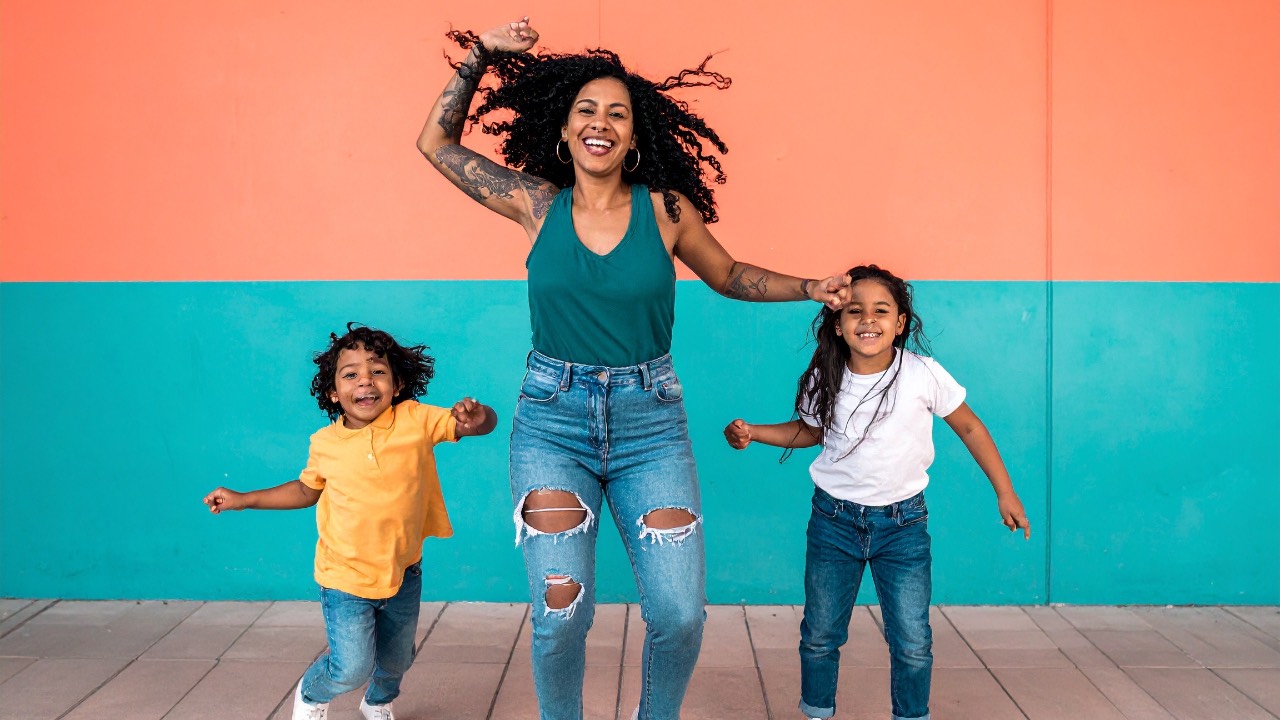
When I turn the music up and start dancing, I am not having a “movement lesson.”
I am dancing.
When we go somewhere strange because I want to see it too, I am not arranging an educational field trip.
I am curious.
When we make something ridiculous, stay too long at the beach, investigate something gross, take a weird detour, make a video, build something that probably will not work, or decide at 10:00 in the morning that today’s plans have completely changed because someone had a better idea, I am not performing childhood for my children.
I am participating in it.
And I think that changes everything.
I think there may actually be a biological reason this works
I have a theory.
And to be clear, I am calling it a theory because I don’t know of research that has tested this exact idea.
But I would not be surprised if someday we discovered that there is something very real happening here.
When a mother is genuinely having fun — when she becomes curious, playful, absorbed, surprised — the entire emotional atmosphere changes.
Children are exquisitely sensitive to the nervous systems of the adults around them.
A mother who is relaxed and delighted communicates something very different from a mother who is evaluating, directing and trying to make an experience “count.”
Her enjoyment gives permission.
It says:
You can become completely absorbed in this too.
And experiences that carry strong emotion, novelty, curiosity and personal meaning tend to be memorable.
That makes intuitive sense to me.
Think about your own childhood.
You probably do not remember page 47 of your fourth-grade workbook.
But you may remember the afternoon somebody let you build a fort in the living room.
You remember the frog you found.
The song you played 800 times.
The bizarre thing your mother agreed to do.
The time something went terribly wrong and everyone laughed until they couldn’t breathe.
Emotion makes experiences sticky.
Fun makes us pay attention.
Curiosity keeps us there.
And attention is where learning begins.
I don’t choose the “best learning opportunity”
This may be the most radical part.
When my children ask me to do something, I am not mentally calculating which option will provide the greatest educational return.
That thought genuinely does not enter my mind.
I ask myself whether I want to do it.
If the answer is yes, great.
If the answer is no, I may say no.
That means our life is not organized around providing the children with an endless stream of optimized enrichment.
It is organized around being actual people who live together.
Sometimes their idea sounds fun to me.
Sometimes my idea sounds fun to them.
Sometimes one of us convinces everybody else.
Sometimes we abandon the whole thing after seven minutes.
Sometimes we become obsessed with something for three weeks.
That is life.
And strangely enough, when you stop organizing childhood around learning, children do an astonishing amount of learning.
Maybe the mother’s joy is not incidental
Traditional parenting culture has an odd relationship with mothers having fun.
We are very comfortable with mothers working hard.
Sacrificing.
Driving.
Scheduling.
Preparing.
Supporting.
Volunteering.
Researching.
Standing beside a soccer field holding twelve water bottles.
But a mother structuring family life partly around her own delight can sound almost scandalous.
I think we have this backwards.
Maybe a mother’s joy is not something we are supposed to squeeze in after everyone else’s needs have been met.
Maybe it is part of the ecosystem.
Maybe children benefit from living around an adult who is still interested in the world.
Someone who laughs loudly.
Who gets obsessed with strange ideas.
Who says, “WAIT. I have an idea.”
Who still climbs on things.
Who wants to know what happens when you smash the watermelon.
Maybe one of the greatest things we can give our children is the experience of growing up beside an adult who has not forgotten how to play.
Unschooling moms have more fun
So yes.
I am officially saying it.
Unschooling moms have more fun.
Or at least we should.
I am currently threatening to turn that sentence into a bumper sticker, because frankly I would put it on my car.
But underneath the joke is something I believe very deeply.
Unschooling is not about becoming your child’s full-time teacher.
It is about building a life where curiosity, freedom, relationships and actual living have enough space to do what they naturally do.
And Mom gets to be alive inside that life too.
So maybe the next time you’re wondering whether something is educational enough, try asking a completely different question:
Would this be fun?
And perhaps an even more important one:
Would this be fun for me?
You may be surprised how much everybody learns once nobody is trying quite so hard to make learning happen.
Want to try unschooling without turning your house into a school?
Download my free unschooling resource for a simple, real-life introduction to learning without curriculum, coercion or recreating the classroom at home.
Keep Questioning
Thought-provoking essays about parenting, freedom, healing, and living a life that actually feels like your own.
No spam. Just ideas worth thinking about.
